

This is the essay I submitted to Dwarkesh Patel’s “Big Questions About AI” blog contest. It’s a fitting subject since my last essay discussed the need for institutions to help solve the wealth inequality gap and get ahead of it before AI widens the chasm even further.
It is also the other side of my techno-optimism. My previous essay celebrated AI as a technology for human advancement, but acknowledged that the real question is one of ownership. Who benefits from AI’s impact on society?
The internet could have followed in the footsteps of the personal computer and democratized wealth and ownership for society. It didn’t, because those who shaped it were not trying to. George Packer’s article in The Atlantic captures the ethos of David Sacks and the PayPal Mafia:
But these 20- and 30-somethings were not inspired in the same way that the founders of earlier Silicon Valley companies were: “They didn’t follow the vision of Steve Jobs, that tech can democratize power. They came to get rich.” McNamee added, “If their value system had been different, we would have a completely different country today.”
AI is here and it’s the most consequential general-purpose technology of our lifetime. Who benefits from the wealth it generates will determine the course of the next decade and beyond. That’s why, for Dwarkesh’s essay contest, I chose to answer this question:
“With OpenAI’s new raise at an $852B valuation, OpenAI Foundation’s stake is now worth $180B. Anthropic’s cofounders have pledged to donate 80% of their wealth. Nobody seems to have a concrete idea of how to deploy 100s of billions (soon trillions) of wealth productively to “make AI go well”. If you were in charge of the OpenAI Foundation right now, what exactly would you do? And when? It’s not enough to identify a cause you think is important, because that doesn’t answer the fundamental problem of how you convert money to impact. Identify the concrete strategy you recommend pursuing.”
If you enjoy this essay and want to read more about my thoughts on technology, health, and philosophy, please subscribe.
AI enhances individual capability more than any general-purpose technology since electricity. Having built Trovable in three months, for $3,500, and with no software building experience, I am living proof. But it is also widening the chasm between those who cross it and those who don’t. On day one, I would convene the other AI labs and the federal government to create the American Technological Consortium: a trillion-dollar fund by 2028, with dollar-for-dollar federal matching, to ensure those most at risk can cross.
Most American distributive programs have failed the same way: The primary resource arrives without the necessary complements. The Homestead Act and the roll-out of the internet were largely deemed successful, but each was littered with failure. At the root of these failures were our institutions. That pattern is our blueprint.
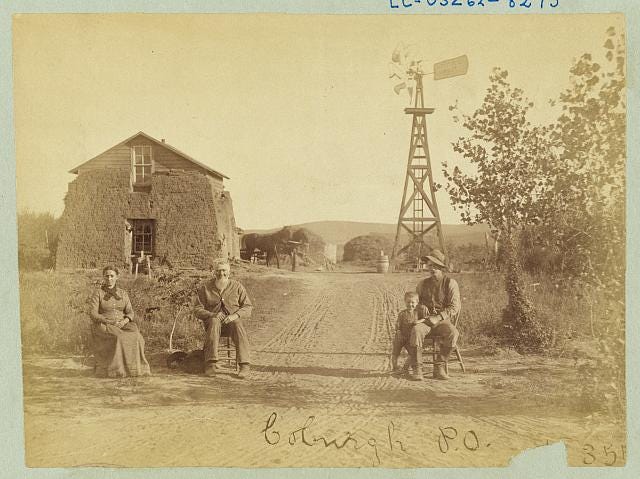
The Homestead Act gave US citizens the right to claim 160 acres in the West. Yet more than 50% of claims failed, and many successful claimants eventually sold to large companies. Claimants had few water rights, no credit or insurance, and no training. Congress partially anticipated this. That same year, they created the Department of Agriculture and passed the Morrill Land-Grant Act, which together distributed agricultural knowledge, and funded state colleges that taught agricultural and mechanical skills. But credit, insurance, and water went unaddressed. A single bad year could leave a family destitute. Water rights, based on a first-in-time appropriation, concentrated control among mining companies, cattle barons, and agricultural operations, leaving settlers beholden to the wealthy gatekeepers.
Land was distributed broadly, but power—the water and credit—was concentrated by few.
If the Homestead Act was a government trying to help its people, while partially failing, the internet roll-out was a government not even trying. The personal computer democratized control. You bought it, owned it, and could do extraordinary things with it. The internet had this same potential to democratize information. But the founders and investors built around a different business model: attention.
Platforms like Meta created walled attention gardens, stifling off-platform links and selling targeted “access” to advertisers. These mega platforms were preventable. Tim Berners-Lee, creator of the World Wide Web, pushed for regulatory changes. He proposed virtual data lockers, called Pods, to enable individuals to own their identity, social graphs, and data. But his, and others’, efforts never found political footing.
Where public policy took a hands-off approach to regulating the attention economy, they took an equally damaging hands-on approach to another resource: education. The internet rewarded agency, curiosity, and executive function. Meanwhile, our educational institutions doubled down on standardization by passing No Child Left Behind, and again with Common Core. Both raised the literacy floor, but taught compliance precisely when the economy was signaling for the opposite.
Access was distributed broadly, but power—platforms and data—was concentrated by few.
The AI economy must do what neither moment did: distribute the primary and complementary resources in the same act. Building on Sam Altman’s proposed Public Wealth Fund and universal AI access, the ATC treats compute as the primary resource, but progressively distributed. Those furthest from the frontier should receive the most.
Education for the AI economy already exists in schools like Alpha School. But that education is only available to the few who can pay. There is also an existing paradox. The most literate are at the highest risk of displacement, while workers least exposed live in low-literacy communities where autonomous robotics will arrive without transition infrastructure.
The ATC would fund the institutions closest to those at displacement risk. Community colleges and workforce centers are the descendants of what the Morrill Act stood up a hundred and sixty years ago. The instruction is simple and progressive: the further a person sits from the frontier, the more compute and the more fellows they receive. The distribution loop is not meritocratic, but diagnostic. When a site falls short, we ask which complement is missing, not whether they should receive the next allotment. The specifics of curriculum, of formula, of fellowship design, belong to the people who run those institutions. My job is to make sure they are given the frame, the funding, and the honesty to know whether it worked. The ATC’s most lasting move is the coalition it seeds for a future Department of Technology: the institutional complement to the primary resource the ATC distributes.
By year three, three milestones will measure whether our dollars are converting to impact: compute delivered to 10 million Americans in the lowest-income zip codes, bi-partisan support for USDT authorization, and one policy act that advances AI literacy in education.
One could argue that an OpenAI-led ATC recreates the very condition I just discussed. The coalition of frontier labs and the federal government is not the settler arriving in Nebraska with a wagon and a prayer; it is the mining company that already owns the river. Every consortium of incumbents in American history—from the railroad land grants to the 1996 Telecommunications Act—has ended by entrenching them. Why should the ATC be different?
Entrenchment thrives both in the dark and through the revolving door of insiders. Railroad land grants turned public settlement into private deals. The Telecommunications Act promised competition, but resulted in mega-mergers among incumbents. The ATC must be designed to accommodate human nature. Every dollar and compute credit would be recorded in a public ledger within 30 days. Frontier labs would receive minority voting rights, board seats would rotate regularly, and there would be a prohibition on self-dealing dollars and compute.
I do not know whether compute literacy arrives before displacement. What I do know is, for fifteen years, I’ve dreamed of building software applications and tools. This year, I built a functional app in three months. The difference was not knowledge or skill. It was teaching myself AI literacy. The question the OpenAI Foundation must answer is how to ensure everyone can convert their ideas into real-world solutions. On day one, I would seed the ATC with $180 billion so we do not repeat past mistakes.