

Technology, however jagged the trajectory of progress, solves problems that once defined daily life: back-breaking labor, undetected diseases, and often early death. Before industrialization, more than four in ten children never lived to see their fifth birthday. Today, a child born in America can expect to live until their late seventies, nearly double the life expectancy from a century ago. This did not happen by chance. Things that we now have the privilege of taking for granted—refrigeration, plumbing, germ theory, vaccines—were the result of painstaking discovery and curiosity, one invention at a time. This is why I’m a techno-optimist.
And yet the instinct to reject and oppose progress most often comes from those who’ve had the luxury of benefitting from it.

AI is here and, from a technological capability standpoint, it is the worst AI we’re ever going to have. From his exquisite article, Steve Yegge (a former Amazon and Google engineer during their civilization-shaping eras), writes about the bittersweet feeling he observed of employees at Anthropic:
“At Anthropic every single person and team I met, without exception, feels kind of sweetly but sadly transcendent. They have a distinct feel of a group of people who are tasked with shepherding something of civilization-level importance into existence, and while they’re excited, they all also have a solemn kind of elvish old-world-fading-away gravity. I can’t quite put my finger on it.
But I am starting to suspect they feel genuinely sorry for a lot of companies. Because we’re not taking this stuff seriously enough. 2026 is going to be a year that just about breaks a lot of companies, and many don’t see it coming. Anthropic is trying to warn everyone, and it’s like yelling about an offshore earthquake to villages that haven’t seen a tidal wave in a century.”
Opposing the force of artificial intelligence will be like trying to stand your ground to stop that tidal wave.
General-Purpose Technologies bring Unpredictable Change
In 1998, Nobel Prize-Winning economist, Paul Krugman wrote, “The growth of the internet will slow drastically… by 2005 or so, it will become clear that the internet’s impact on the economy has been no greater than the fax machine.”
Although he has since acknowledged it was a silly thing to write for a throwaway essay, he defended his broader argument that the internet-skeptics were right and the internet did not result in greater productivity gains. He wrote that the productivity gains from the internet were modest compared to the gains of 19th and 20th century technological advances.
His argument hits at something important. Was the internet more impactful to society than electricity, plumbing, or modern transportation? From a statistical standpoint, no. The real problem is how we measure productivity. As new general-purpose technologies are invented, we keep using the same metrics to measure their success. The real benefit of general-purpose technologies often doesn’t get measured at all: How much they decentralize access by lowering the cost of entry.
What Krugman did not take into consideration is two-fold:
Much of the general use-cases for the internet, like search, maps, and email, were free. These don’t show up in economic statistical charts, but they enormously expanded the capacity of the individual.
The economic gains that did manifest were consolidated in small pockets of the economy due to lenient enforcement of antitrust policy that enabled companies to gobble up smaller companies (Google acquired Youtube and Android, Facebook acquired Instagram and WhatsApp), reducing competition and increasing their moats. Because of this, the enormity of wealth created resided mostly in owners rather than laborers.
Think of all the things you can accomplish today that you couldn’t 20 years ago. Streaming on demand, trading securities from your couch, meeting with colleagues in real-time across the world, sharing your work with millions of viewers. Could we have predicted any of these in 2005?
Because of habituation—the process by which our excitement to a given stimulus decreases with repetition—what was once extraordinary is now merely commonplace. Think of everything you put in your refrigerator. Do you give it much thought? I certainly don’t. But imagine how exciting it must have been in the mid-1910s when the first consumer refrigerators were being sold and families could suddenly store perishables at home.
“That’s kind of the sad thing about technology is that once it becomes a protocol, it ceases to be magical.” — Jean-Marc Daecius
The Decentralization of General-Purpose Technologies
How much autonomy did the refrigerator give to families? Instead of having to make daily trips to the market, or the butcher, families could buy a week’s worth of groceries and store them at home. The internet did the same thing on an even larger scale: it freed us from linear TV, dependency on gatekeepers for information, and the need for a middleman to distribute your work. Each time, the pattern is the same: general-purpose technologies reduce our dependence on what came before.
AI is taking this same pattern and accelerating it at an unprecedented rate, affecting nearly every industry. Where the internet democratized access to information, AI is democratizing access to creation.
I have no idea how to write or read code. I tried to learn, but it never stuck. So when OpenAI released ChatGPT to the public in November of 2022, I was one of the first to see what I could do with it. At first, I thought it was way too overhyped. The single biggest red flag was how confidently the AI got so much wrong—it reminded me of one of my dad’s favorite quotes, “Often wrong, but never in doubt.” But when new technologies are invented, they are always in their worst form; they only get better through continual iteration and user feedback. As the models were upgraded, the hallucinations diminished.
I’ve since learned that using AI is like learning how to exercise properly: patience and iteration are the key drivers of success. Prompting AI is a conversation, not a Google search. Now, after 15 years of personal training, with no knowledge of software programming, Trovable is a live, fully functional website. Designed by me and developed by artificial intelligence. This is where the magic lies in general-purpose technologies. I’ve long dreamt of being able to build software, but it was always too daunting. “What sucks?” is a mantra I’ve clung to for coming up with ideas, but the true “What sucks?” for me was never knowing how to act on them. Sure there are still flaws and yes, the AI certainly doesn’t get everything right. But if I had to choose between impossible or possible with caveats, I’ll take the latter every time.
But as the tools for creation become commoditized, costs go down, and access widens until the skill to build is no longer scarce. Human judgment becomes the scarce resource.
A Coming Resurgence of Liberal Arts
Like when I give my four-year-old too much independence, these newfound freedoms often come with consequences. Streaming gave rise to binge-watching and a dramatic increase in screentime. Freedom of information meant anyone could build an audience and pass themselves off as an expert. The removal of middlemen flooded our eyeballs and ears with noise, making it harder to know what’s true and what’s worth your precious attention.
The benefits of decentralization come with the tradeoff of responsibility. With the coming tide of AI, individuals will need more of it than ever. Being able to detect what is real is getting more difficult. Lazy work—having AI do all of your work for you without checking it—is getting easier. Although AI is terrific for conducting research, the sources still need to be verified. Our ability to think critically and apply logic is paramount.
In 1998, Neil Postman argued that “technological change is not additive; it is ecological.” When a new technology is invented, the ecosystem is fundamentally changed. Electricity did not leave America intact and add one more convenience to it. Electricity reordered American life. When the ecosystem changes, the skills necessary to thrive in it change as well. We are witnessing this ecological shift in real time with AI.
Since the early 2010s, liberal arts took a back seat to STEM, and for an arguably good reason. Since 2009, STEM graduates typically earn 37% more income right out of college than their liberal arts peers. What’s not often told is that by the age of 40, the income gap significantly narrows. Now, with AI commoditizing access to building software, what matters is an individual’s ability to reason and think critically. We need a resurgence of liberal arts in its classical form.
Liberal arts stems from artes liberales: “Education befitting a free person.” It’s rooted in training the mind to think critically, apply reasoning and logic, and use rhetoric to communicate persuasively. All of these qualities are essential for an AI-driven world. The best AI models can now solve problems that PhD-level physicists and mathematicians face. The best human chess player will never again beat the best computer. Where does that leave us? With an incredibly powerful tool. That’s all it is. AI is an exceptional tool for productivity. But it’s still the user’s inputs that determine the outcome. How do you know which problem to solve and where to direct your attention? How do you know if you’re asking the right questions? How do you know if you’re getting the right answer from the AI?
For the better part of the last four generations, Corporate America was the safe path: A steady job, a roof over your head, a means to raise your family, and a cabin for the next generation. It’s easy to forget that before the Industrial Revolution and the Gilded Age that followed, there was no Corporate America. Agriculture was this country’s number one profession and business ownership was the norm. Industrialization mechanized farming, electrified the production of goods, and motorized transportation. Machinery commoditized the agricultural and artisanal skills needed in the previous era, and we entered a new era of averages and standardization—Taylorism.
This next era will return us to small-scale business ownership and entrepreneurship being commonplace. One person can now use a vast array of tools to build a business that solves problems for their customers. The greatest cost to any business—and what stops people from starting—is the cost to hire another person. But with these tools, a company that would once have required hundreds of people may now be possible with ten, or fewer.
That might sound scary. We’re living through Joseph Schumpeter’s “Creative Destruction” theory and it is historically painful for many hard-working people. The 50-year stretch from 1870 to 1920 saw the invention of electricity, the telephone, radio, refrigeration, the modern-day combustion engine, and the assembly line. These inventions were part of a major ramp up of industrialization. However, it was equally brutal on the labor force. Rampant job displacement and exploitation, and the monopolistic culture of the Robber Barons meant an entire generation endured a great deal of suffering. The benefits eventually spread to everyone, but at great cost.
We must do better this time and I believe it starts with understanding the teachings of the classical liberal arts. One of the best things that came out of this historical period was the astounding increase in literacy rates, especially among minority populations. However, a key reason was that companies needed a labor force equipped for urban life in an industrial age: operate machinery, read and write, work an assembly line. The education system was deliberately built around these necessities. More than 100 years later, very little has changed in terms of structure: time blocks for subjects, age grouping, class sizes, and standardized testing all still remain.
The system that was designed to teach people to serve the industrial machine is the same system we use to this day. But classical liberal arts is about educating free people. Critical thinking, reasoning, logic, and the ability to communicate them do not serve industry well. But they do serve an individual who wants to think for themself; someone who has ideas, imagination, and questions. Those skills are precisely what using AI require.
Today, you can take your ideas and act on them at a tiny fraction of the cost compared to just four years ago. For context, what I’ve built so far with Trovable would have traditionally taken six engineers (an approximate cost of $1.3million/year), cost $415,000 to develop, and taken a year to build. It took me three months and $3,500.
There is nothing special happening here. I took a passion of mine (listening to podcasts), a passion of my wife, Jasmine’s (reading books), and applied what I know about human behavior. I am immensely proud of what I’ve built. But the real beauty is that anyone with domain expertise or passion can build the app they dream of.
With the barriers to entry diminishing, we must return to the traditional principles of liberal arts. How do we prepare for what’s coming next? My own observations tell me we are nowhere near ready. But we can be. Anyone can learn these skills and anyone can use them to then build something that solves other people’s problems. AI decentralizes our ability to actualize our ideas. We just need to learn how to come up with, and articulate them.
Bifurcating AI the Technology From AI the Power
General-purpose technologies are often met with skepticism and resistance, primarily from the people that the technology displaces. AI is doing something unique in that it is unifying more people than any political party ever has. Unfortunately, that unification is in their shared opposition to using AI: 64% of Americans say they are resisting the use of AI for as long as possible. Understandably, their resistance has merit: it costs billions to train these AI models so it’s the billionaires who are building it, getting even wealthier in the process. The amount of water it requires to cool the data centers is unprecedented. In a world experiencing tangible changes to the climate, where drought is becoming commonplace, this is a genuine touchpoint for many.
Perhaps most damning of all though, are the unforced errors from the people building and selling AI to us. When the CEO of the second-largest AI lab comes out and says, “AI will replace 20% of all entry-level white collar workers,” and, “spike unemployment to 10-20%,” that doesn’t inspire people to root for you; it inspires pitch forks. When that same person writes a 38-page essay explaining that the next few years will determine whether humanity survives AI or “flames out” it doesn’t exude the same excitement as, “We choose to go to the Moon…” Not only is this messaging uninspiring, it’s causing vehement opposition to AI. Worse still, this messaging is causing people not to use it.
Daron Acemoglu, co-winner of the 2024 Nobel Prize in economics, argues that these AI labs need to stop focusing on replacing humans and instead on enhancing humans. His Nobel-winning work argues that technology alone does not guarantee economic prosperity for all. Shared prosperity is dictated by the governing institutions who choose whether or not to regulate the technology. His views are not isolated either. Skepticism, and even direct opposition, to AI is most fervent on both ends of the political spectrum.
Their opposition is primarily to the concentration of wealth in the hands of the few owners, and the immense amount of power they wield by being the sole controllers of the technology. Not the technology itself. The question is about who has control over it, and who prospers.
Historically, regulating new technologies has been the norm in America for the previous century. We regulate what drugs can come to market through an extensive clinical trial process. We regulate safety standards for cars and planes. And we’ve made it illegal for any private entity to create nuclear weapons. It’s worth noting that these controls often follow tragic events. Surely, one could be forgiven for hoping we’ve learned our lesson this time?
As for the question of who prospers, my hope is that we again do not repeat the mistakes of the past where wealth is hoarded by the ownership class—or, we give everyone the opportunity to be a part of the ownership class. Many ideas have been floated within the AI ecosystem. But something I find fascinating about AI is its capacity to solve its own problems, if used properly.
To put this to the test, I prompted Claude to attempt to create a system of wealth distribution for the world we are entering. After four iterations, it came up with, The Complementarity Compact. My contributions were the constraints of the simulations, the ideas to stress-test, and deciding when an iteration wasn’t satisfactory enough. Otherwise, this Compact was generated entirely by AI.
The purpose of this experiment was not to create a work of national policy (Appendix G explicitly states the purpose of the Compact). The purpose was to demonstrate the importance of judgment. My policy experience is nonexistent, as is any work I’ve done at a national level. Yet this document is meticulously thorough and synthesizes the work of experts in this area, such as Acemoglu. Imagine how they will be able to use it to solve these problems. Or, how we can use it in our own domain.
Exponential Curves
Part of the prosperity from new technology is learning to use the technology for our own productivity gains. AI is arguably the greatest augmentation tool for productivity. In the case of Trovable, it took 1/6 the people, less than 1/100 the cost, and 1/4 the time. Someone who is using it will vastly outpace someone who isn’t, and for a much lower cost.
This is not a small, linear augmentation either. Our mind intuitively thinks in linear concepts: as X increases, Y increases correspondingly. But the fundamental nature of modern technology, and why its change is often resisted, is that it compounds exponentially. We see the initial phase of the curve and assume we can predict what the technology will look like in ten years. In reality, predicting even two years out is near impossible.
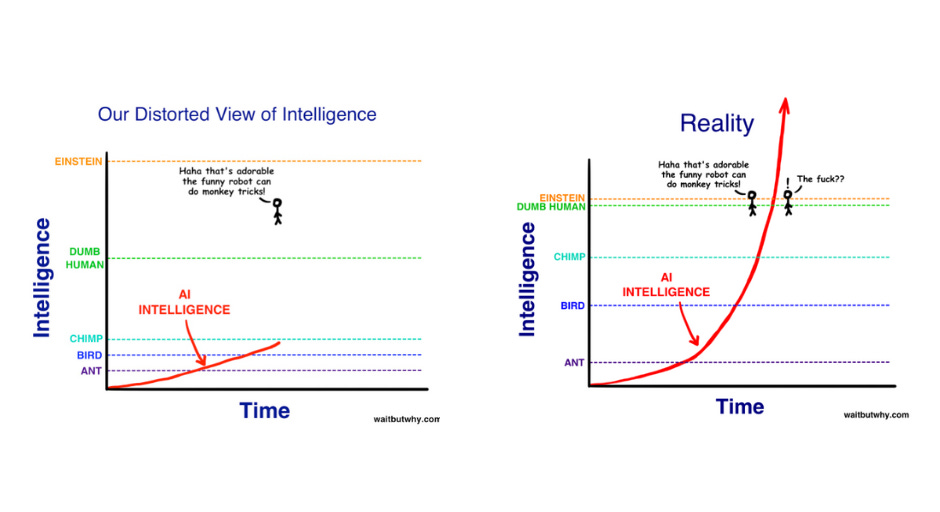
Moore’s Law is the canonical example. In 1965, Gordon Moore first predicted that the number of transistors on a chip would double every year. He later amended his prediction in 1975 to doubling every two years. His discovery has been validated for more than 50 years and driven the expansion of the entire semiconductor industry. It’s the reason our phones are more powerful than the computers that sent humans to the moon, and why a company like Nvidia can build the hardware necessary for AI to exist at all. It’s the reason AI progress won’t slow down anytime soon, and will only continue to accelerate with each new iteration.
Now, extrapolate that across every industry in the world. Not adopting AI for ethical reasons is understandable, but it won’t stop the tidal wave. What it will do is create an ever-widening canyon between those who are and are not using it. Those who are using AI will also have much more say in the direction of the wave. Moreover, companies who are late to AI adoption are in for a reckoning. Those companies employ people. When those companies struggle to keep up with the productivity of their competitors who are using AI, what happens to their people?
In addition to theorizing Creative Destruction, Schumpeter also warned that capitalism would one day cannibalize itself from the weight of change undermining the institutions that hold it up. Maybe AI is that cannibalizing catalyst. A technology that enhances the productivity of the individual so much that it undermines the entire labor market that holds up this country. That sounds alarming. But the answer isn’t to refuse to use the tool. Equipping ourselves with the skills and judgment necessary to give AI the right inputs is how we will ensure our voice has a say in how the tool is controlled.
History Doesn’t Have to Rhyme
In the short term, inequality will almost certainly increase. In Derek Thompson’s conversation with Josh Tyrangiel, they discuss Tyrangiel’s cover article for The Atlantic: “America Isn’t Ready for What AI Will Do to Jobs.” He explains how the CEOs he interviewed are under tremendous pressure from Wall Street to show financial returns from their investments in AI. The best way to show financial returns is by cutting jobs. Even if the technology isn’t ready yet. We are gutting the lowest rung on the corporate ladder—the rung where young people learn invaluable skills to succeed in the workplace and hone their skillsets. Meanwhile, the companies designing this technology, and their investors, are becoming extraordinarily wealthy (OpenAI is exploring a 2027 IPO at a $1 trillion valuation).
Despite this probable eventuality, I remain optimistic. President JFK famously said, “A rising tide lifts all boats.” Despite the positive sentiment, that dream has largely failed to materialize. The inventions of the personal computer and the internet came close; but wealth concentrated in platform-based companies, not the majority of individuals. The industrial boom at the turn of the 20th century resulted in numerous inventions without which modern society would look unrecognizable. Those inventions took generations to reach the general population. We must ensure we do not relive that timeline. AI has the potential to significantly compress the timeline, but only if people are well-equipped with the skills to wield it.
The beautiful thing about general-purpose technologies is that we can’t yet imagine what inventions will be made possible. A man in Sydney, Australia recently used AI and genomic mapping to shrink his dog’s cancerous tumor by 75% in a single month. Mt. Sinai used their deep-learning AI algorithm to detect diseases, before symptoms arose, at a 94% accuracy rate. Scientists are combatting climate using AI to map melting ice 10,000 times faster than humans can, and identify ocean litter for easy removal.
There are many harmful ways to use AI as well, and we cannot discount them. AI deepfake nude abuse in schools is a serious problem. This is again where learning AI literacy, rooted in the same liberal arts principles, is vital to drastically reduce the prevalence of these devastating acts. The skills used to build with these tools are the same skills required to know when they are being used to target and manipulate you.
My three kids will never know a world without AI. They will never know a world where a human is the pinnacle of intelligence. What does that mean for them?
It means that who they become as individuals is far more important than attempting to mold them to fit into an outdated system built on averages and standardization. The classical liberal arts were designed to teach people how to think, and how to solve problems—how to be entrepreneurial. That is how Jasmine and I intend to educate them. From there, they can use it to pursue their curiosity to its absolute limit. This is why I remain a techno-optimist.