This is Part I of a series I intend to write on my experience with artificial intelligence (AI) and my predictions for what this technological shift akin to the coming of the internet will bring.
In this first essay, I will share with you what I have built, entirely on my own (with a ton of feedback and input from my wife, Jasmine), using nothing but AI agents and my own curiosity and the knowledge I’ve gained from consuming hundreds of hours of essays and podcasts about tech, business, entrepreneurship, and artificial intelligence.

What sucks? How can I solve it?
These are two fundamental questions anyone can ask to start any company.
Not knowing how to code was a gatekeeper that kept me from attempting to solve many of the “what sucks?” problems I had thought of over the years. Until AI meant that people like me didn’t need to know how to code. You just need to know how to ask questions, be patient, and keep asking.
And, while I respect that artificial intelligence is causing deep divides among people over the future of work, the enormous taxation on our electrical grid, and the vast amount of natural resources it takes to power the infrastructure necessary for AI to exist, I believe it has more potential to be the great equalizer of wealth and disparity in our society than any force that’s come before it.
The internet had the capacity to lift all boats. But, because of concentrated network effects, companies like Amazon and Facebook concentrated enormous amounts of wealth, it failed to do so. AI can strengthen the power of the individual and take that power away from the platform. A talented, creative individual will be able to build tools to market their talent without relying on gatekeepers: whether it’s building a consumer application (like Trovable, which makes you the main character of your media diet), helping to fill in gaps with writing, or automating administrative work that creators hate.
Kevin Kelly created the concept of 1,000 true fans: Anyone who can build an audience of 1,000 true fans who pay $100/year, or more, can earn a living doing what they love. He was right—Substack and Patreon have proven this. AI may well destroy the middle manager class and reduce the need for white collar service workers. But, it will continue to lower the barriers to entry and bring about the rise of the entrepreneur class with a much more balanced distribution than the internet produced. It will lower the financial and time costs for a creator to both build and curate their audience.
WHY Trovable: Passion in ‘Thinking’
Since my grade school days, I have believed thinking and problem solving were of the utmost importance for a person to learn. In adulthood, I believe the absence of thinking critically is the root problem of most of our problems as a society.
For those of you who know me from Envision Fitness, or reading my essays over the years, you know I ceaselessly ask you to think: Which muscles do you feel working? Where do you think you should feel this exercise? This is partly for scientific reasons—neuromuscular strength is one of the quickest adaptations our body makes when we start strength training—but mostly it’s because I am passionate about inspiring the act of thinking.
“Where do you feel it?” applies to much more than just biomechanics. When you’re emotionally triggered, how often do you stop to ask, “Where do I feel this?” Anecdotally, animal videos hit me particularly hard—both happy and sad videos. I feel them viscerally, more than any other type of content. I used to react impulsively with a comment, or allow myself to be pulled into the algorithmic wormhole. But being attentive to our internal mechanisms creates pattern recognition. Pattern recognition enables the formation of a disciplined response that isn’t impulsive, but rather one we’ve chosen.
The Wise-Mind technique was created by Marsha Linehan in the late 1980s (and formally published in 1993) to help people who were suicidal and used as a tool to help them find balance in both accepting and changing themselves. It dictates that when we find ourselves emotionally triggered, we recognize it and apply our logical mind as a form of counterweight. Our Wise Mind lies at this intersection of reason and emotion, applying both in equal measure. Too emotional, and we act on instinct, little different than an animal. Too logical and we leave out what it means to be human—we lose sight of our core values.
Social media companies do not want us to be wise. We are not their customer (to be fair, in some cases social media companies do charge a subscription in exchange for removing ads). Their customers are advertisers who sell more of their products when we’re in a state of emotional reactivity. It’s not just them. All media does this to a degree. I love The Lord of the Rings. My logical mind knows it’s not real, but my emotional mind buys into the world J.R.R. Tolkien built.
The difference is choice. With traditional media, we can slow down and take our time. We can recognize a wonderfully crafted story for what it is, and extract from it what we choose—our Wise Mind at work.
The rapidity of scrolling puts our emotional mind in a persistently triggered state, while our rational mind struggles to keep up. We don’t know if what we’re seeing is true or false. Add AI-generated content into the mixing bowl and now we also don’t know if what we’re seeing is even real or not. Social media in its current form is designed to strip us of our choice.
Trovable is my attempt to give it back.
Breaking the Dopamine, Doomscrolling Feedback Loop
Dopamine is not about pleasure—it is about the expectation of pleasure, entirely dissociated from the actual experience of enjoyment. The allure of scrolling was built upon the same psychological foundation that makes slot machines so profitable for casinos. When we scroll, we don’t know what we’ll see next. That’s the genius of the algorithm: to keep showing us things that will reach us on an emotional level and keep us wanting more.
While I believe social media is an invaluable tool for raising awareness and keeping people informed, I simultaneously hold it responsible for the social climate we find ourselves in. As users, we are herded into echo chambers. Echo chambers create “Us vs. Them” divisions. These divisions cause a level of online vitriol we would never have in real life discussions. When ‘rage bait’ is named Word of the Year we’ve hit new lows of people’s ability to think critically. When experts are discounted and dismissed in favor of social media prognosticators, we’ve abandoned truth in favor of belief—not unlike the Dark Ages and the denigration and stagnation of cultural and scientific progress.
We need ways of countering this toxicity.
This was my “What sucks?” moment.
This is Trovable
Trovable helps you discover content you'll actually love.
Trovable is what I envision social media can be: a way to stop scrolling through the morass of noise, and instead find a true signal; a way to avoid the emotionally triggering influencers who profit by sowing fear and anger.
The query engine is intentionally designed to give you verified, quality content based on what you’re looking for—prioritizing active, established creators and filtering out inactive accounts that haven’t published in over a year. No scrolling, no unintended emotional triggering. Moreover, if you are searching for specific content that can have many different perspectives (e.g. politics), the engine is designed to give you multiple, differing viewpoints. Whether you read, watch, or listen to those differing viewpoints is entirely up to you, but the feature is to help us avoid our own echo chambers of confirmation bias.
One of my favorite features of Trovable is that it is designed to learn with you. The more content you read, watch, or listen to, and the more you review content, the more personalized your recommendations will be.
Here’s how it works:
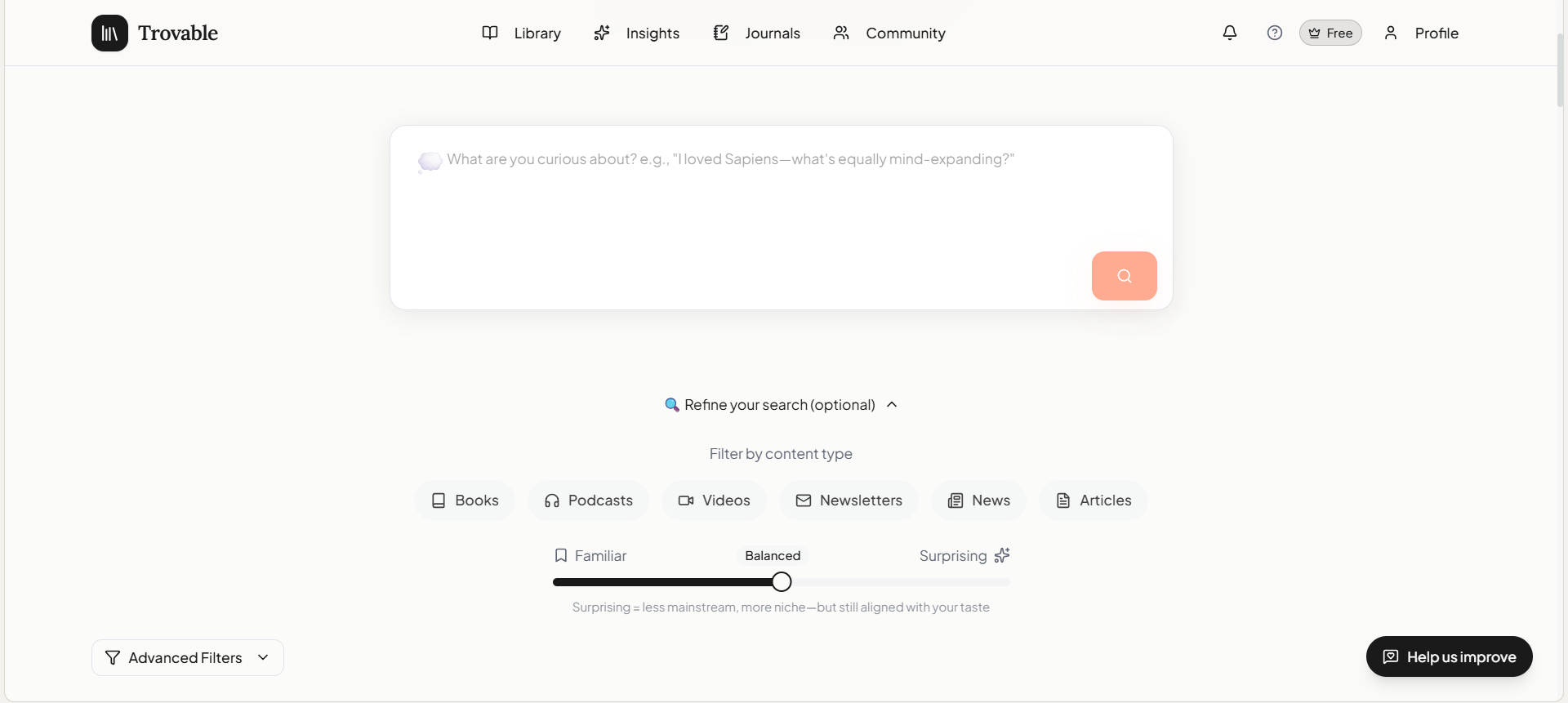
On the homepage, you can filter which kind of content you are looking for. Specificity is king. The more you narrow your parameters, the more personalized the answers will be.

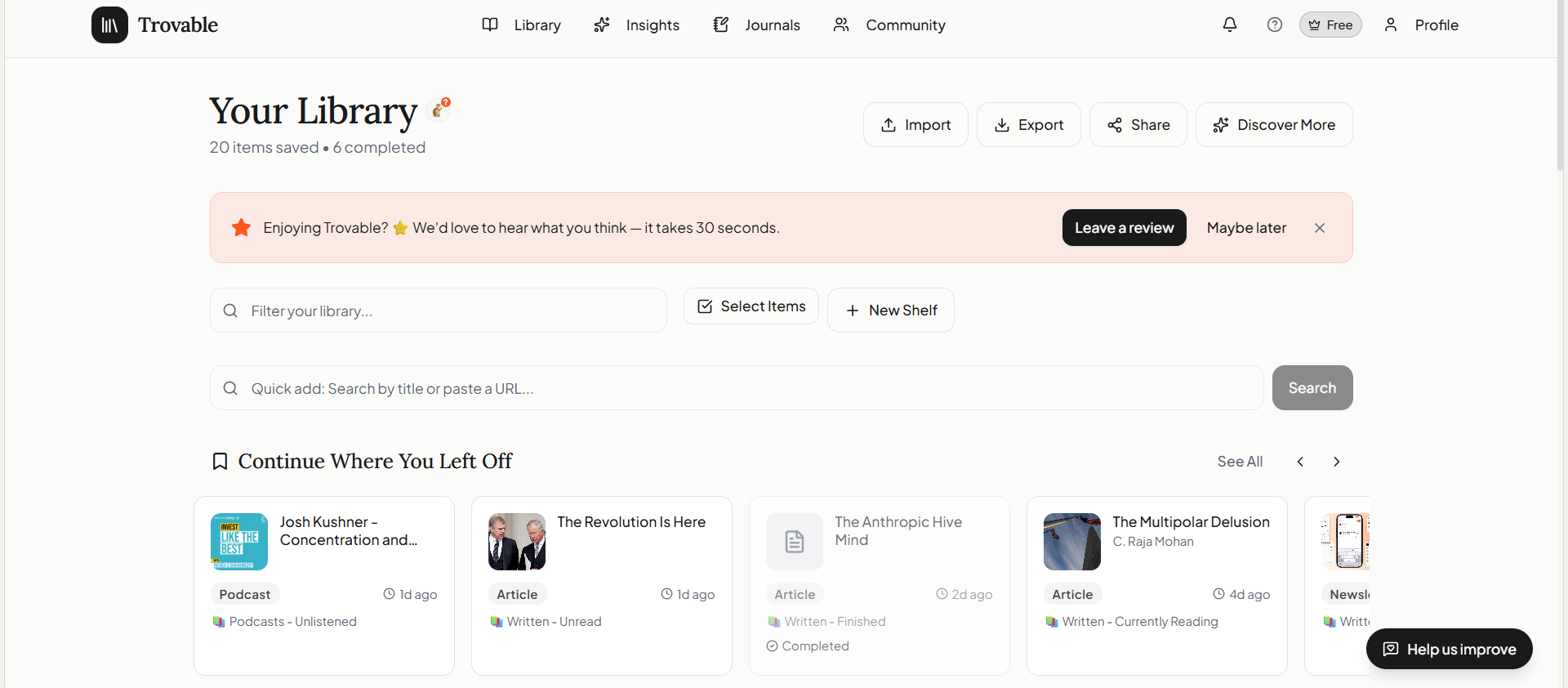
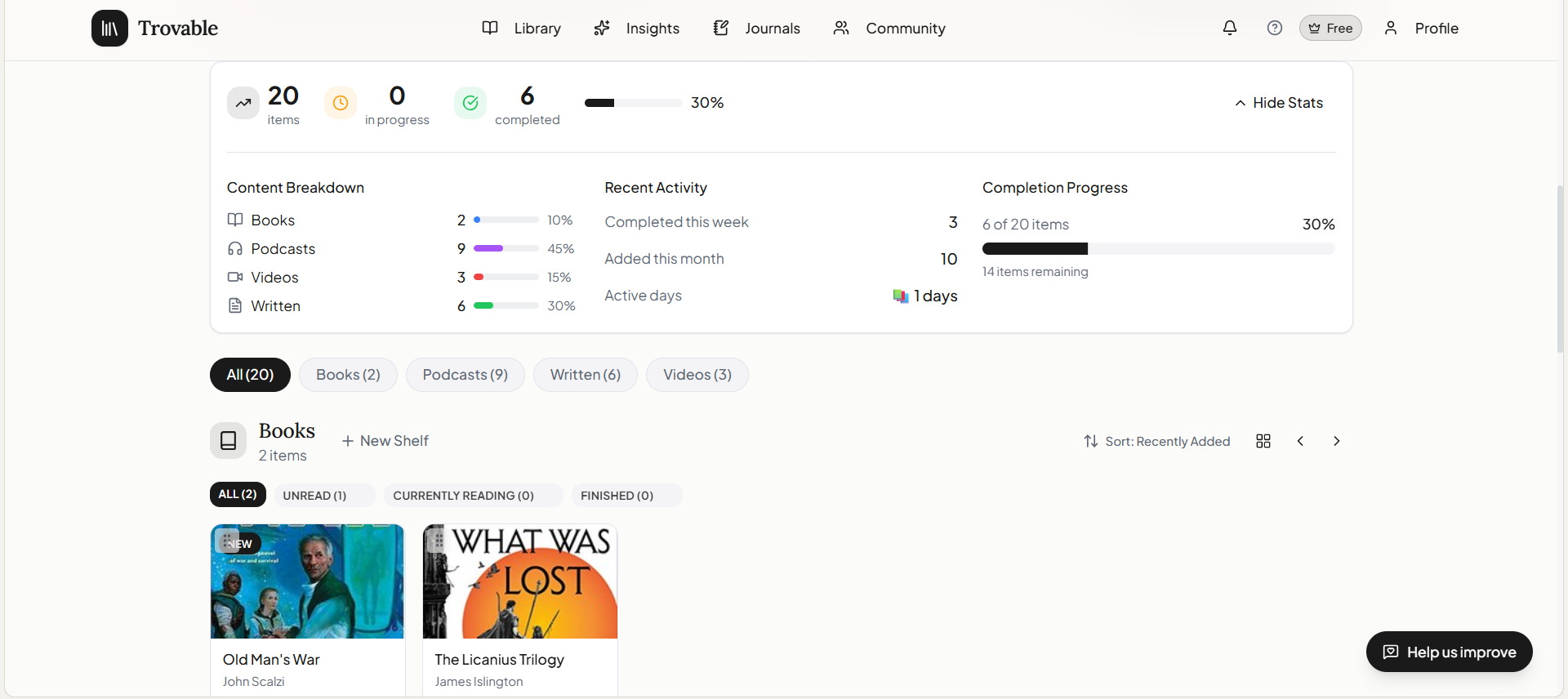
Within Trovable, you can build your own library, fully customizable to your own preferences. You can create your own shelves and click+drag content you’ve saved into their appropriate shelves, as well as rate each item and write yourself notes about it.


You can also create and join ‘pods’—book clubs, podcast clubs, newsletter circles, or general discussion groups. A “group chat” version of social media, where you can meet people with similar interests and discuss ideas.

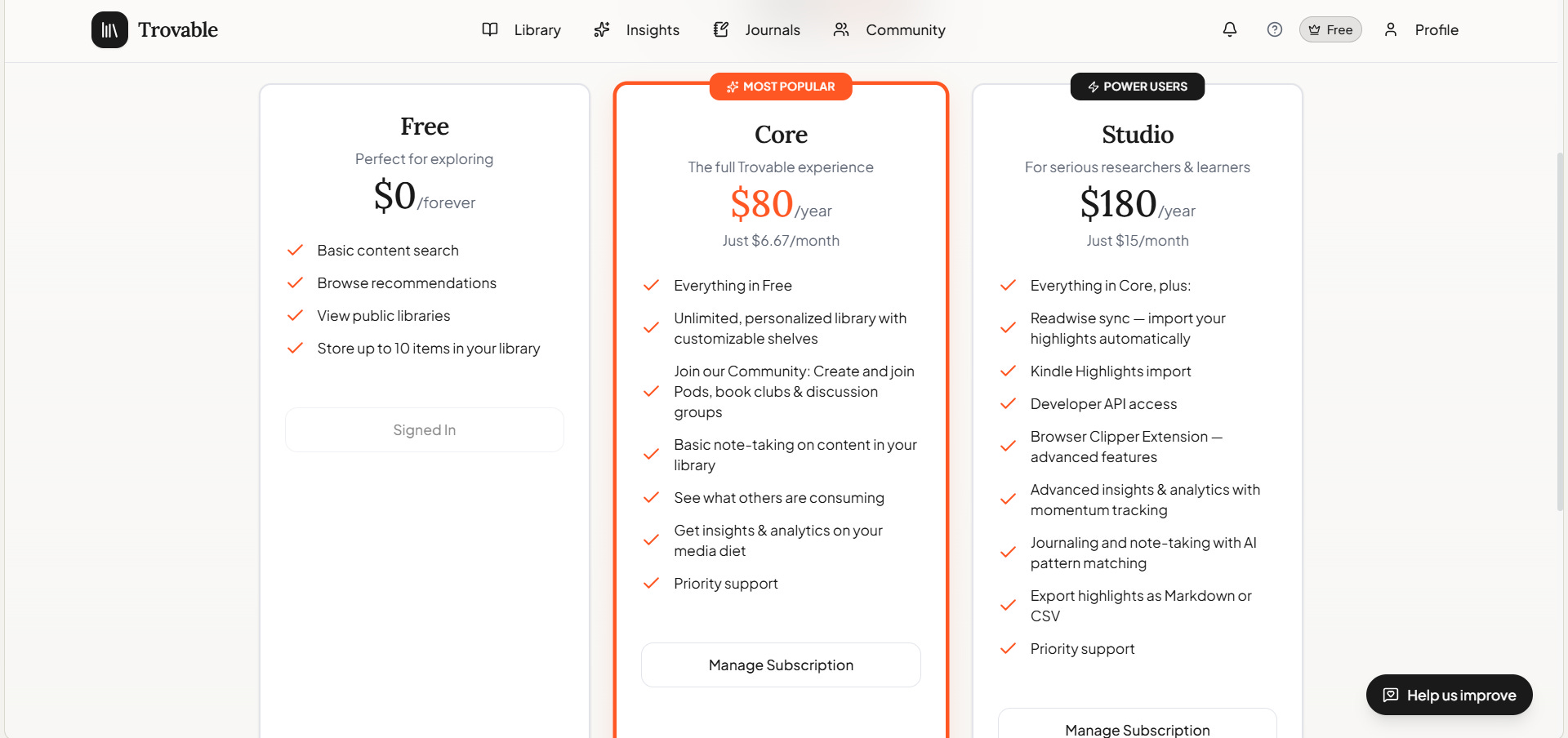
Our studio tier enables members to sync their Readwise, Notion, Zapier, and other accounts to Trovable, as well as use our advanced note-taking and pattern recognition tools.

We also just shipped our browser extension which enables you to save what you’re reading, listening to, or watching to your Trovable library. Better yet, you can read, listen to, or watch that content in Trovable!
Paywalled content is only available to view in Trovable if you are logged into your account on that company’s platform.
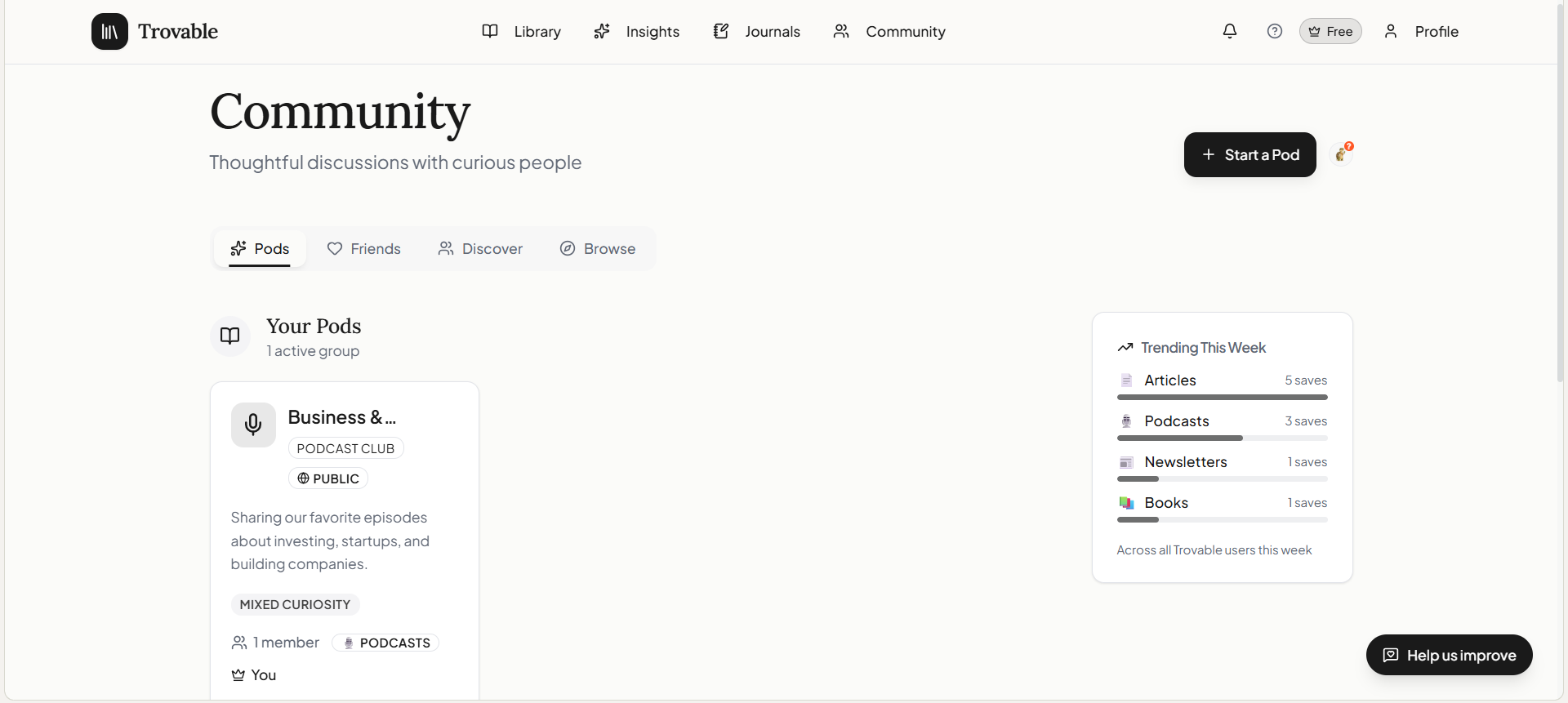
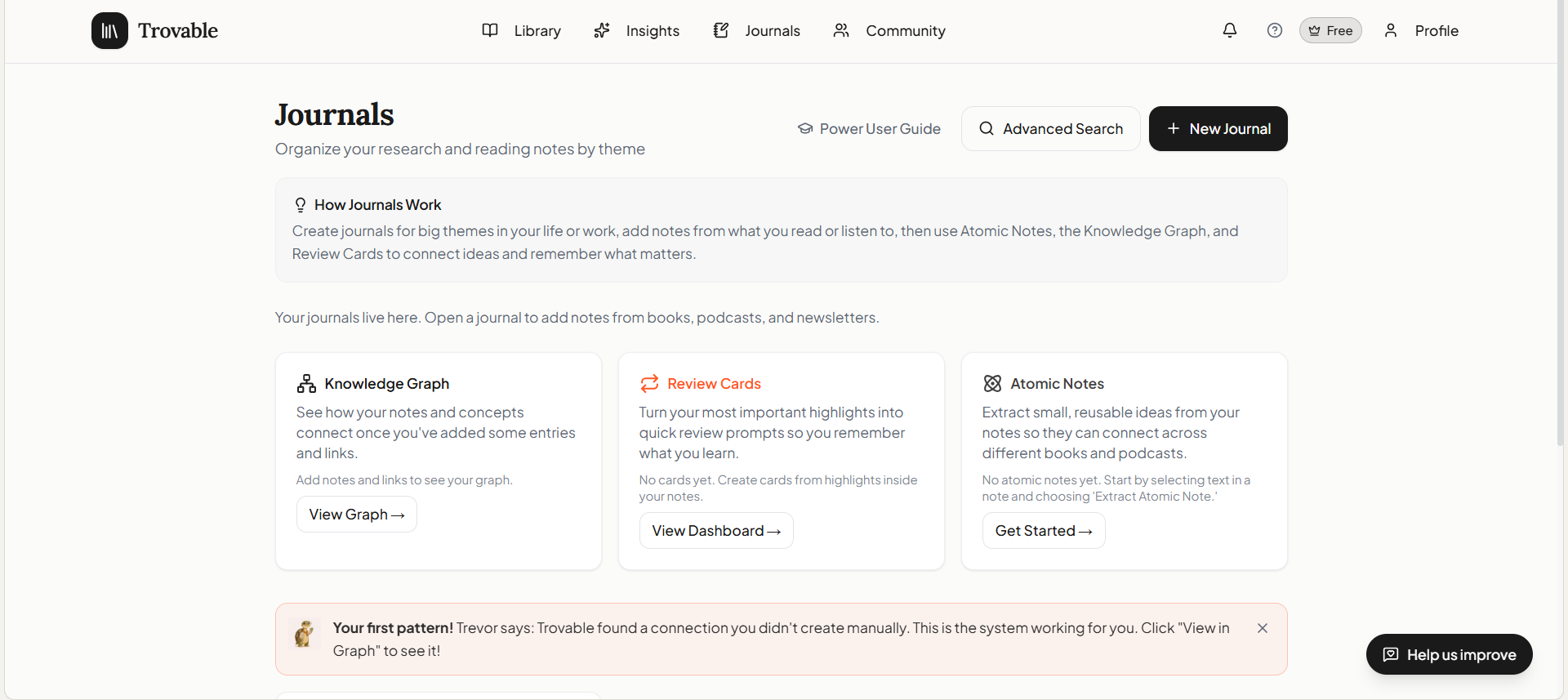
Our philosophy, as explained by Trevor, the Troving Turtle, is to slow down and explore our curiosities; to consume content we actually enjoy and want to learn from; to form meaningful connections with other curious people.
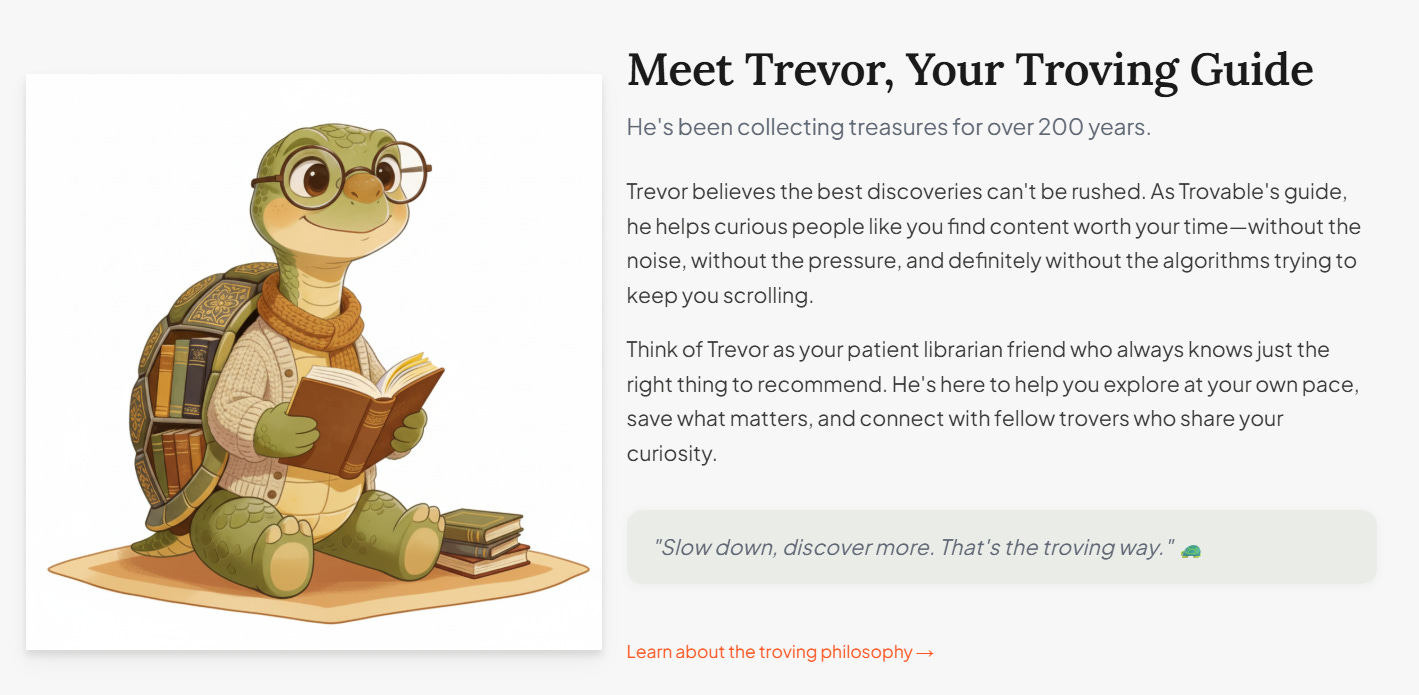
Your attention is precious and worth protecting.
Welcome to Trovable.
Thank you for reading.
If Trovable sounds like the tool for you, I am launching a BETA test of our premium services. We’re not yet in the app store, but you can download Trovable as a Progressive Web App (PWA) by going to our website, Trovable.app. The site will ask you if you’d like to download the app. We’re fully operational in your browser, or as an app.
If you would like to be a BETA tester of Trovable, you can go to Trovable.app/Beta and enter in the code: EARLYBIRD26
This will give you access to all of the features in both our Core and Studio tiers: